One analyzer, across the work you already do.

Equine, companion, production, and shelter practice each ask something different of a diagnostic. The same analyzer covers all four — at the yard, on the bench, at the unit, and at intake.

What it does, where you do it.

Equine, companion, production, and shelter work each ask something different of a diagnostic. What follows is what the Search Analyzer does in each of them.

Equine

A laboratory that travels in the vehicle.

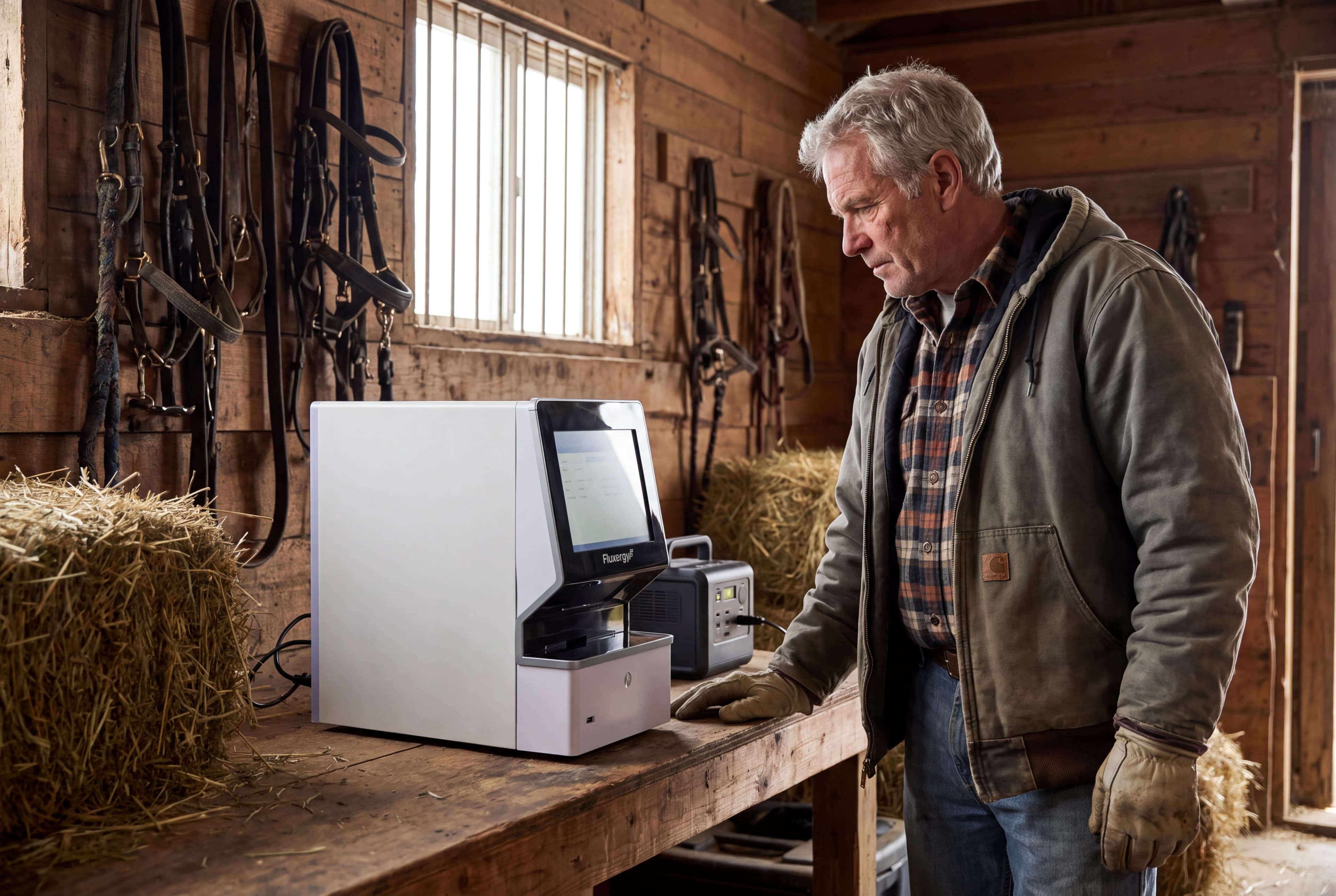
Ambulatory work happens wherever the vehicle stopped, so the analyzer is built to go there. It runs on what a mobile unit can supply, tolerates being driven around, and is operated by the person already handling the horse — sample preparation happens inside the card, so the work at the yard is loading one and reading the screen.

That puts molecular, immunoassay, and chemistry work at the yard rather than a day away from it. The farm call that took the sample becomes the farm call that acts on it, without a second trip out and without the horse standing on a presumptive treatment while a courier catches up.

Each finished run reaches FluxOS as soon as it completes, so the result is in the practice record before the vehicle is back — and the next visit is planned against an answer rather than against a note to follow up.

What it changes here

A yard visit that settles the question, rather than one that starts a two-day wait.

Companion animal

Four classes of test on one bench, for a caseload that asks for all four.

A morning in general practice runs from a vomiting dog to a cat losing weight to a pre-anaesthetic panel, and each of those asks a different class of test. The Search Analyzer covers molecular, immunoassay, chemistry, and cell-based work on one instrument, so what stays in-house stops being decided by which analyzer the practice happened to buy.

One sample load covers every assay on a card. A practice that would otherwise run a rapid test in-house and send the rest out gets to keep the whole question in the building, on a bench that has room for one instrument rather than four.

Results reach the analyzer and FluxOS at the same moment, while the client is still in the room. That is the only point at which a result can change what is agreed — and it is the difference between explaining a plan in person and leaving a voicemail two days later.

What it changes here

A consult that ends in a plan, instead of in a callback nobody is sure will happen.

Production animals

Screening at the unit, at a cost per test that lets you run more of them.

Herd decisions are taken at group scale, so what matters is how widely and how often a test can be run. Fluxergy builds its own analyzers and cards on its own production lines, and owning the manufacturing is what pulls the cost of each test down — an affordable test is one a unit runs routinely rather than rations to the animals that already look sick.

Running at the unit takes the round trip out of the loop entirely. A decision to move, treat, hold, or isolate gets made on the day the samples were taken, instead of after days of feed, restricted movement, and whatever is spreading carrying on spreading.

Because the analyzer travels, one instrument covers several units on a round, and every run from every site lands in the same record through FluxOS rather than in a folder per holding.

What it changes here

A population picture that sharpens, because testing more animals stopped being the expensive option.

Shelter and high-volume

An answer per animal at intake, at a cost the intake budget can carry.

Intake testing is a volume problem before it is a clinical one. The platform is built around an affordable consumable and an operator who does not have to be laboratory staff, which is what makes screening every admission a standing workflow rather than an exception made for the animals that look unwell.

Running it at intake means the isolation call is made once, on the day the animal arrives. No healthy animal holds a ward place it does not need while a send-out comes back, and no carrier enters the general population in the meantime.

One instrument covers the classes of question intake actually asks, and every result is attached to the animal's record from its first day through FluxOS.

What it changes here

Isolation space spent on the animals that need it, decided at the door.

What changes, and what doesn't.

Where the analyzer sits and what it displaces differ by the work. The platform underneath does not, and that is the argument for running it in a practice that does more than one of these.

Where the analyzer sits
Equine — the mobile unit, at the yard
Companion — the treatment room or the in-house bench
Production — the unit itself, or the farm office
Shelter — intake, alongside the admission exam
What it replaces
Equine — a courier, and the second farm call that waits on it
Companion — a bench of single-purpose analyzers, and a send-out for everything they miss
Production — a laboratory round trip per group decision
Shelter — a per-animal send-out the intake budget cannot sustain
What the operator does
Loads a prepared sample into a card, inserts it, and reads the screen — no pipetting, no calibration step, and no requirement that the person running it be laboratory staff
What stays the same
One analyzer, one sample per card, four assay classes, and the same protocol library behind all of it

Which panels are published for veterinary use, and the sample each one takes, are listed on the test menu. Which species a given panel has been validated in is established per assay — ask us before planning around one.

Which of these is your practice?

Most are more than one. Tell us what the mix looks like and which of it currently leaves the building, and we'll walk through what changes when it doesn't.