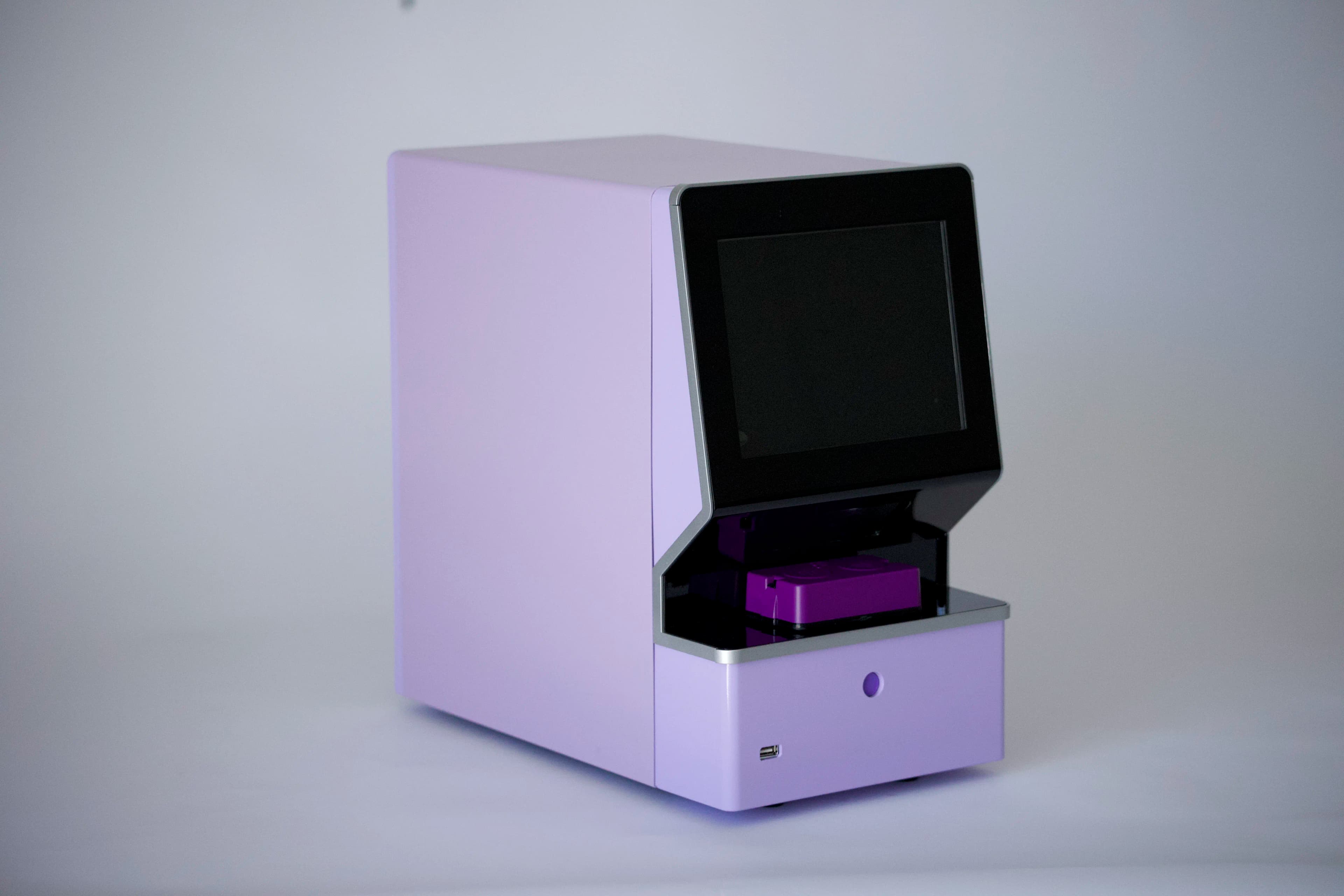
One card chassis. Whatever panel you need.
A modular microfluidic design lets the same card carry completely different test configurations — which is what makes multimodal testing affordable per result.
- Markers per card
- Up to 30
- Panel types
- 5
- Sample prep
- On-card
- Cards shipped
- 250K+
The consumable is where the assay actually lives.
The Search Analyzer provides the optics, fluidic control, and compute. Everything specific to a test — the chemistry, the channel network, the reaction zones — is designed into the card.
One chassis, many layouts
Every card shares the same outer geometry and analyzer interface. The channel network inside is what changes between panels.
Sample prep on board
Lysis, plasma separation, metering, and wash steps happen inside the card — there is no separate extraction bench.
Reagents shipped dry
Assay reagents are dried into the card and rehydrated during the run, which is what keeps storage and shipping simple.
Panel identity built in
The Search Analyzer reads the card and pulls the matching protocol from FluxOS, so the operator never selects an assay by hand.
Five panel classes, one workflow.
Each card class runs on the same analyzer with the same handling steps. Changing what you test for means picking a different card, not retraining an operator.
Molecular (PCR)
Amplification and real-time detection for pathogen and genetic targets.
- 12+ markers per card
- On-card lysis and prep
- Multiplexed reaction zones
Immunochemistry
Antigen and antibody panels with integrated wash and incubation steps.
- 12+ markers per card
- Automated wash sequences
- Fluorescent readout
Clinical chemistry
Metabolic, enzyme, and electrolyte assays read by absorbance.
- 12+ markers per card
- Dried on-card reagents
- Plasma separation on-card
Multiplex cytometry
Cell counting, viability, and population analysis through on-board imaging.
- Imaging-based counts
- No external staining rig
- Runs from whole blood
Multimodal cards
The reason the platform exists: different assay classes on one card, from one sample, in one run.
- Up to 30 markers
- PCR + immunoassay + chemistry together
- Single sample load
Up to 30 markers from a single sample load.
A multimodal card runs PCR, immunoassay, and clinical chemistry side by side on one sample. That is the workflow a central lab would spread across three instruments and several days.
Cost-effective because we build them ourselves.
Consumable cost is what decides whether decentralized testing is viable at volume, so card manufacturing is treated as core technology rather than as a supplier relationship.
Made in-house
Cards are manufactured on our own lines rather than outsourced, which is what keeps unit cost — and lead time — under our control.
AI-driven process control
Inline inspection and process models catch drift during production instead of at final QC, holding card-to-card consistency.
Lot traceability
Every card carries its lot identity into FluxOS, so a result can be traced back to the material and the line that produced it.
Built to scale
The shared chassis means a new panel is a new channel layout on an existing line, not a new manufacturing process.
Specifications.
A working summary of the consumable. Panel-specific documentation, validation data, and regulatory status are available from our team.
- Format
- Single-use microfluidic card, one card per run
- Panel classes
- Molecular (PCR)ImmunochemistryClinical chemistryMultiplex cytometryMultimodal
- Markers per card
- 12+ per single-modality panel; up to 30 on a multimodal card
- Sample types
- Whole blood, plasma, serum, urine, swab eluate, and other prepared samples
- On-card processing
- LysisPlasma separationMeteringWash stepsReagent rehydration
- Reagent storage
- Dried on-card reagents rehydrated at run time
- Instrument
- Fluxergy Search Analyzer — no additional hardware required
- Traceability
- Lot and card identity recorded against every result in FluxOS
- Custom panels
- Available through Fluxergy OEM services
Need a panel we don't list?
Existing cards cover common test orders, and OEM partners bring their own assays onto the same chassis. Tell us what you need to measure and we'll tell you what it takes.